Where should I keep my Will?

Where should I keep my Will?

So, you have taken the important step to make your Will but what should you do with it now?

Your Will is extremely important as it sets out, to those that you have left in charge (your Executors), exactly what should happen, upon your death, to your Estate – your money, property and possessions. 

If you do not have a Will then your Estate is passed on in accordance with the Rules of Intestacy, this may not be how you had intended, or would have wanted.

If your Will cannot be located upon your death then your Executors, or the Administrators of your Estate will have to deal with your Estate as though you had not made a Will.

Your original Will is the only legally binding document that will be accepted by the Probate Registry in order that your chosen Executors can distribute your Estate to those that you have chosen, in accordance with your wishes.

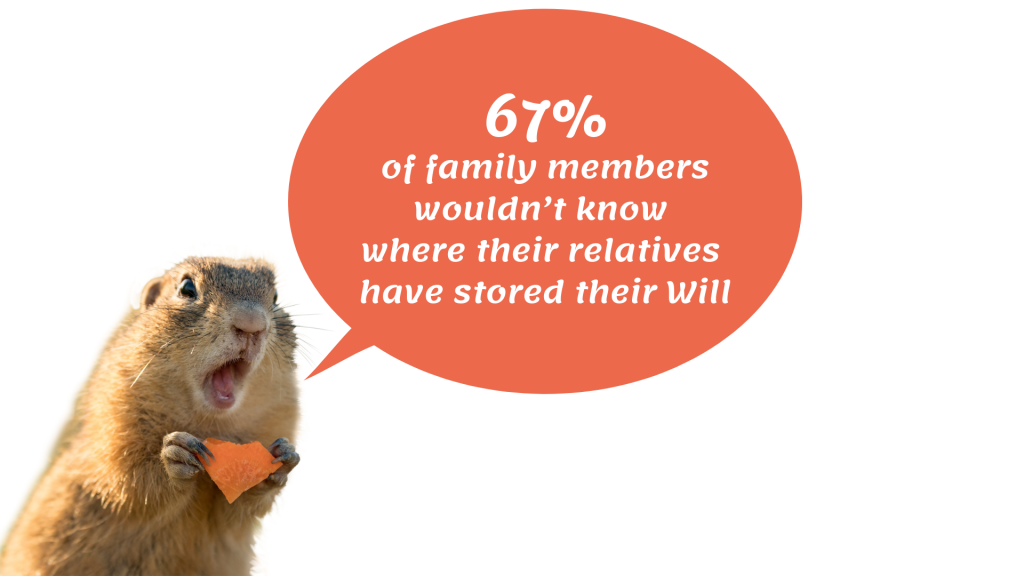
Many people choose to store their Will in their own home but recent research suggests that 67% of family members wouldn’t know where their relatives have stored their Will.

family_members_wouldn’t_know_where_their_relatives_have_stored_their_Will

Storing your Will at home also has the additional worry of ensuring that it is protected against any flood or fire risk as well as being taken, among other valuable possessions, in the event of a burglary.

Storing your Will in a secure location, and advising your Executors of this, is essential – especially after going to the effort of making a Will and getting all your wishes down!

If you would like to have a chat with us about storage options, please do. These are low cost and include the option to amend your Will, at no additional cost, whilst your Will is stored with us.

If you would like to have a free chat about your existing Will, making a new Will or storage of your Will, please contact us on info@TotalLegacyCare.co.uk or 01727 865 121

Leah Waller

Got a Question or want to book a FREE Consultation?

Divorce: How does it affect my Will?

Divorce: How does it
affect my Will?

We all know the part “til death do us part” but sometimes, and ever more commonly, marriages end in Divorce – 108,421 in 2019. Some divorces are amicable, some not so much…

After taking all the time (not to mention legal costs!) in agreeing on how money, property & assets are separated, is a Will still valid?

The simple answer is Yes. If you have a valid Will whilst you are still married then divorce does not revoke your Will and so it remains valid.

Marriage on the other hand does invalidate a Will (unless your Will includes your intended marriage).

In some cases, you may not want to change your Will. Your Will, made when you were married, may well state who your assets should pass to and this may not change. However, upon divorce your ex-spouse will be treated as having died at the date that the Decree Absolute is given and so will no longer be Executor, Trustee or Beneficiary under your Will unless contrary provision is made in the Will.

So, what should you do if you do want to change who will inherit your estate, and how easy is it to change?

You can revoke a Will at any time (providing you have capacity to do so) and this is quite simple to do. 

If you make a new Will at any point in your life it will revoke any previous Will that you have made (providing it is done properly). 

So, when should you consider changing your Will? 

You can make a new Will at any time and so it may be worth considering this after separating from a spouse. You do not have to wait for the divorce to be finalised or the Decree Absolute in order to finalise a new Will. 

What if you get remarried? 

It is not uncommon nowadays for individuals to have second or subsequent marriages. 

As mentioned above, when you get married your Will becomes invalid unless your Will states your intended marriage and so it is important to review your Will and make sure it is still in place and does what you want it to. 

Another consideration upon a subsequent marriage is your children. If you have children from a previous marriage then they may not receive any of your Estate if you die without a valid Will in place. Again, it is always best to review your Will on a regular basis to ensure your wishes are carried out. 

If you would like to have a free chat about your existing Will or making a new Will, please contact us on  info@TotalLegacyCare.co.uk or 01727 865 121

Neil Barras-Smith

Got a Question or want to book a FREE Consultation?

Inheritance Tax: Record £5.2billion paid by UK in 2017/18

Inheritance Tax: Record £5.2billion paid by UK in 2017/18

With the Government collecting £5.2billion in Inheritance Tax last year, it is well worth considering whether your estate is liable for Inheritance Tax.


Although the record amount of Inheritance Tax paid in 2017/18 is nothing to be sniffed at, with only one in twenty estates actually paying Inheritance Tax there are ways of ensuring that your estate is not liable for Inheritance Tax, but in order to do so we must consider when Inheritance Tax is payable.


Inheritance Tax is payable upon death, where an estate exceeds the Nil Rate Band, at a rate of 40%. So, what is the Nil Rate Band?

The Nil Rate Band is a personal allowance, that each individual is able to gift, upon death, without attracting any Inheritance Tax.


The Nil Rate Band for 2018/19 (this is considered every April) is set at £325,000 per person, this may not seem like a lot considering the increase in property prices. However, in addition to the Nil Rate Band, if you are passing property to a direct descendant (a child, grandchild, great-grandchildren, step-children, adopted children or foster children) then you are entitled to claim the Residential Nil Rate Band. The Residential Nil Rate Band is currently set at £125,000.


If you are married and the estate is passed to the surviving spouse upon the death of the first spouse, then no Inheritance Tax is payable. Don’t worry, the deceased’s Nil Rate Band and Residential Nil Rate Band is not lost…

Upon the death of the surviving spouse, the Nil Rate Band and Residential Nil Rate Band can be combined to allow for the estate to pass to a direct descendant without attracting Inheritance Tax up to a value of £900,000 (in the 2018/19 tax year) by taking advantage of both spouses Nil Rate Band and Residential Nil Rate Band.


With the Government committed to increasing the Residential Nil Rate Band by £25,000 to April 2020, by the tax year 2020/21, an estate that includes a property and that is taking advantage of both spouses Nil Rate Band and Residential Nil Rate Band will be able to gift £1million to a direct descendant without attracting any Inheritance Tax.


If your estate is valued at over £2million then your use of the Residential Nil Rate Band attracts conditions and so if your estate is valued at over £2million then we will need to consider your exposure carefully to limit this where possible.


If you would like to have a free chat about your Inheritance Tax liability and planning for the future, please contact us on  info@TotalLegacyCare.co.uk or 01727 865 121


Leah Waller