Divorce: How does it affect my Will?

Divorce: How does it
affect my Will?

We all know the part “til death do us part” but sometimes, and ever more commonly, marriages end in Divorce – 108,421 in 2019. Some divorces are amicable, some not so much…

After taking all the time (not to mention legal costs!) in agreeing on how money, property & assets are separated, is a Will still valid?

The simple answer is Yes. If you have a valid Will whilst you are still married then divorce does not revoke your Will and so it remains valid.

Marriage on the other hand does invalidate a Will (unless your Will includes your intended marriage).

In some cases, you may not want to change your Will. Your Will, made when you were married, may well state who your assets should pass to and this may not change. However, upon divorce your ex-spouse will be treated as having died at the date that the Decree Absolute is given and so will no longer be Executor, Trustee or Beneficiary under your Will unless contrary provision is made in the Will.

So, what should you do if you do want to change who will inherit your estate, and how easy is it to change?

You can revoke a Will at any time (providing you have capacity to do so) and this is quite simple to do. 

If you make a new Will at any point in your life it will revoke any previous Will that you have made (providing it is done properly). 

So, when should you consider changing your Will? 

You can make a new Will at any time and so it may be worth considering this after separating from a spouse. You do not have to wait for the divorce to be finalised or the Decree Absolute in order to finalise a new Will. 

What if you get remarried? 

It is not uncommon nowadays for individuals to have second or subsequent marriages. 

As mentioned above, when you get married your Will becomes invalid unless your Will states your intended marriage and so it is important to review your Will and make sure it is still in place and does what you want it to. 

Another consideration upon a subsequent marriage is your children. If you have children from a previous marriage then they may not receive any of your Estate if you die without a valid Will in place. Again, it is always best to review your Will on a regular basis to ensure your wishes are carried out. 

If you would like to have a free chat about your existing Will or making a new Will, please contact us on  info@TotalLegacyCare.co.uk or 01727 865 121

Neil Barras-Smith

Got a Question or want to book a FREE Consultation?

Only 55.2% of Lasting Powers of Attorney applied for in September 2018 were registered, WHY?

Only 55.2% of Lasting Powers of Attorney applied for in September 2018 were registered, WHY?

Statistics from the Office of the Public Guardian show that a total of 77,541 applications to register Lasting powers of Attorney were received in September 2018 alone (59,079 paper applications and a further 18,462 online applications) BUT only 55.2% of those were completed and registered by the Office of the Public Guardian.

So, with so many applications (500 more applications in September 2018 compared to August 2018) it is clear that the importance of putting an LPA in place is recognised by many but why are so many applications not registered?

The application forms are lengthy and do not require completion by a professional and so many opt to make the applications themselves to save money.

However, a Certificate Provider is still required to sign each Lasting Power of Attorney to certify that the Donor (the person making the application) understands the power that they are giving in the LPA, have not been forced or pressured into making the LPA, there is no element of fraud in the application and that they have no cause for concern. This certificate provider must be independent and have known you for at least two years or be a doctor or lawyer.

Although much of the form may seem simple and easy to complete, with just over half of applications being completed by the Office of the Public Guardian, what are the most common errors?

We spoke to the Office of the Public Guardian to ask what the most common mistakes were, causing applications to be rejected and found the following:

  • Inconsistency

The form is lengthy and requires the completion of both the Donor’s details and the Attorney’s details (the person being given the power by the Donor) in numerous boxes and inconsistency with this – whether this be incorrect spelling, inconsistent spelling, inconsistent dates of birth or address – this can cause the application to be rejected.

  • Dates

The application forms require signatures and the date that those signatures were completed to be inserted a number of times and the order in which this must take place is strictly stated in the forms. If this strict sequence is not followed, or dates are missing, this can cause the application to be rejected.

  • Outside the box

The signatures throughout the form must remain inside the boxes given and so if the signatures go outside the box, this may cause the application to be rejected.

With an £82 application fee, that is not refunded if the application is rejected, it is important to ensure your application is completed correctly and also ensure the application is in place ready for when you need it. The form being rejected or sent back to be rectified can cause significant delays and this may well have severe consequences.

Lasting Powers of Attorney allow you, the donor, to give power to the person, or people, you trust most, to make decision for you when you are unable to.

Total Legacy Care are able to provide a Certificate Provider when completing your application for a Lasting Power of Attorney.

If you would like to have a free chat about Lasting Powers of Attorney, please contact us on  info@TotalLegacyCare.co.uk or 01727 865 121

Leah Waller

Got a Question or want to book a FREE Consultation?

The Grieving Process: Do we all go through the same process when dealing with the loss of a loved one?

The Grieving Process: Do we all go through the same process when dealing with the loss of a loved one?

It is often said that there are five stages of grief, as initially identified by psychiatrist Elizabeth Kubler-Ross. However, this was originally identified in relation to dealing with a terminal illness rather than the process that we go through when dealing with the loss of a loved one.

So, is the grieving process the same, regardless of what we are grieving? Are we really such simple beings, that such an awful time in our lives can be identified in a few simple stages experienced by all of us, no matter the circumstances?

It is highly unlikely, as individuals we are all complex beings and the grieving process is a tragic period that each of us will deal with differently.

Having considered, in-depth, the grieving process we set out below some of the stages that have been identified within the grieving process, how these are dealt with, or may present themselves and how these may be alleviated.

Five Stages of Grief or Seven Stages of Grief?

A good place to start may well be seen as the five stages highlighted by Elizabeth Kubler-Ross, however, the five stages of grief have been updated by a model of grief that has identified seven stages of grieving and whilst these are similar to those identified by Elizabeth Kubler-Ross and indeed combine some of those stages, they have expanded upon these.

The five stages highlighted by Elizabeth Kubler-Ross are:

  1. Denial;
  2. Anger;
  3. Bargaining;
  4. Depression; and
  5. Acceptance. 

In the model of grief that identifies seven stages of grieving these are recognised as:

  1. Shock and Denial;
  2. Pain and Guilt;
  3. Anger and Bargaining;
  4. Depression, Reflection and Loneliness
  5. The Upward Turn
  6. Reconstruction and Working Through
  7. Acceptance and Hope

Denial and Shock

The initial stage for many of us, when grieving, is likely to include some form of denial or sheer disbelief that the loss has happened or that the person is no longer around. This can sometimes be somewhat shocking and difficult to comprehend immediately, leading us into a stage of disbelief, shock and even denial that the death has taken place. It will of course, depend on the circumstances surrounding the death and whether the death was sudden and unexpected and so the element of denial may therefore be different and last longer in some situations than in others.

The initial stage of denial often allows us to cope with the necessities of day-to-day life and making plans as and when required, such as the immediate requirements following a death and making funeral arrangements. Denial is often seen as a mask used to cope and get through what we have to before the enormity of the situation fully hits us.

Pain and Guilt

As the initial stage of denial subsides, the enormity and sheer weight of the situation will descend upon us. Although difficult and painful, this is often seen as one of the most important stages to deal with, as it is important to deal with this pain and any guilt that may be felt rather than ignore it or avoid it. It is during this stage, although not exclusively, that many of us may be susceptible to unhelpful coping mechanisms such as alcohol or drugs.

The guilt associated with this stage may not be directly related to the death of the loved one, or even their cause of death, rather a guilt for things that were not said between you and the loved or things that were not done whilst the opportunity was there.

Anger and Bargaining

Anger can take many forms and there is no limit, and often no reasoning, to who this anger may be felt towards. Anger may be felt towards those around you, the professionals around at the end of the deceased’s life (such as doctors, nurses and healthcare professionals) or even towards your loved one that has passed away. The anger that is felt can last for varying lengths of time and will vary depending on who this is aimed at. This will be an extremely difficult period, as with all the stages, but especially for those around us who may well suffer as a result of our anger but feel helpless in alleviating the pain that is felt by us, or the root of such feelings. As with any pain and guilt it will be necessary to deal with any anger that is felt, rather than suppressing it, as dealing with the anger can help move us forward individually and help us consider those feelings that have been unearthed.

The bargaining stage is a stage that many of us go through, not just after the loss of a loved one but throughout our lives during difficult or traumatic periods, asking for just one thing, a temporary position or change, in return for some sort of bargain from ourselves, such as an offer of giving up anything for just one more conversation with that loved one or a bit more time. Bargaining may also take the form of questioning, such as “why was the illness not diagnosed sooner” or “what if I had have noticed a change more quickly”, “could I have changed the outcome”, this will all be necessary in dealing with the death of a loved one but can also bring with it pain, guilt and anger.

Depression, Reflection and Loneliness

Dealing with the loss of a loved one by feeling somewhat depressed, sad, down and low, is not a weakness, this is not something that should be hidden or disguised. It is most natural for us to suffer emotionally following the loss of a loved one and depression can take differing forms depending on the individual. Depression may well lead to unhelpful coping mechanisms such as excessive alcohol usage, drug use or dependence on prescription medication.

During this stage, as with any period of depression, it can last for varying lengths of time and may well demonstrate itself as a withdrawal from aspects of our usual day-to-day life and activities in favour of spending time alone to reflect. This may also lead to loneliness and a sense of being alone with no one that can understand the position we have found ourselves in.

The period of reflection, looking back on fond memories and even considering how we may be able to move on with our own life following such a loss is often entwined with the depression stage as such thoughts can cause more distress but will be necessary when dealing with the emotions and how we are able to process the death and eventually look ahead to dealing with the loss.

The Upward Turn

The Upward Turn may well seem like a distant vision that you can only dream to achieve when first dealing with the loss of a loved one, a vision that seems impossible to achieve or even imagine, but it will come. This will take time and the there is no right or wrong as to how long is too long, we are all individuals coping in our own way.

We will eventually begin to feel as though we can begin to process much of our own daily life without the heavy weight, or grey cloud, burdening our every moment.

Reconstruction and Working Through

This stage is not included within the five stages that were initially identified by Elizabeth Kubler-Ross but is seen as the stage in which we begin to become more present in our own lives, rather than just mindlessly struggling through (and in some cases, appearing to cope) and where we are able to deal with the loss of our loved one and find solutions to problems that we may be facing in our own lives, that we may well previously have relied upon the deceased loved one for help in resolving.

During this stage we will look to bring structure back into our own lives and begin resolving matters that we may well have been ignoring, or let slip, following the initial loss of our loved one.

Acceptance and Hope

This is not necessarily us being fine with the loss of our loved one or even us concluding that the death of our loved one was acceptable or necessary but rather entering a stage of acceptance of the events that have happened rather than remaining in a stage of denial.

This stage should allow us to feel some hope for the future and begin making plans for the future and as though we are able, or will be able to, enjoy future events and experiences without our loved one being there in person.

Having acceptance of the loss of our loved one, and hope for the future, does not mean that we move on and never again grieve for that person, but rather that we are in a better place to deal with our own life and circumstances. Although we may dip at times and feel low, we are able to be present again in our own life and have an acceptance of those tragic circumstances that we found ourselves in.


Help is at hand…

At the outset, we can often appear, to the outside world and even those that we are closest to, that we are coping (somewhat well!) with the situation and being practical and pragmatic in our approach to getting things sorted. However, this is often deceptive and, as set out above, we have not yet even begun to process the situation, just merely dealing with what is necessary before we can begin to unload and consider the circumstances that we are now in.

Although appearing fine, and in some circumstances, actually feeling as though we are in control and able to cope, we are not alone and do not have to take on the burden by ourselves.

Our family and loved ones can provide a great foundation and support network for us in bringing structure back into our own lives and helping us to cope and deal with the pressures of our usual life without our loved one.

Although many of us will be reliant on our loved ones throughout this period, whether that is in terms of our own emotional wellbeing or with the necessary tasks that need completing following a death, grief is traumatic for all those involved and your loved ones, who are there to support you, are likely to feel helpless at this time and unable to assist or alleviate your pain.

Seeking medical assistance from a healthcare professional or your GP, Nurse Practitioner or a Counsellor may also be necessary to talk through some of your feelings and your mental and emotional wellbeing.

There are also professionals that can help (whether that be bereavement counsellors, advisers, solicitors, probate professionals or other professionals) and alleviate some of the burden you may be feeling.

Keeping yourself busy at this time is a coping mechanism but this may well prolong the time in which this period lasts and so getting help, from whatever source you find best, can really help.


A relatable phrase that I have often read is:

Death is neither fair nor unfair, it is simply a reality.


This phrase is often worth remembering at a time where we are putting immense pressure on ourselves and feeling guilty for what has happened and trying to find someone to blame, find answers or make sense of the situation.

As set out previously, we all deal with experiences differently and so dealing with the death of a loved one and grieving is no different. Some of us may follow the five stages of grief, some of us the seven stages of grief and yet some of us may only experience one, or some, of those stages of grief. That doesn’t mean we are wrong, or that the models of grief are necessarily wrong, we are all humans, we do deal with situations differently, there is no one size fits all or one fix for all of us.


If you require any help or assistance we are always happy to have free initial consultation, please contact us on Info@TotalLegacyCare.co.uk or 01727 865 121.


This does not constitute medical, psychiatric or any advice and any opinions are of the writer’s. As stated each individual will deal with circumstances differently and should consult their own advice if required.

Leah Waller

Got a Question or want to book a FREE Consultation?

Why invest in a Funeral Plan?

Why invest in a
Funeral Plan?

A funeral plan is not a ‘just in case’ product, it’s a ‘definitely will need’ product. As blunt as it sounds, at some point all of us will die, an uncomfortable but unavoidable fact.

Having a funeral plan will help relieve your loved ones of both the financial and emotional burden of arranging your funeral when the time comes.

Would your loved ones know what your funeral wishes are?

  • Only 1% of people organising a funeral knew all of deceased’s wishes;
  • 18% did not know any of the deceased’s wishes;
  • 46% did not know if their loved one wanted cremated or buried;
  • 64% did not know whether to hold a religious or non-religious service.

(Cost of Dying Report – 2018)


There are so many considerations when arranging a funeral, such as:

  • burial or cremation?
  • location?
  • transport?
  • viewings of the body?
  • religious service?
  • what hymns and/or songs would you like played?
  • order of service?
  • obituary / readings?
  • flowers?
  • charitable donations?

A Funeral Plan will help to set out exactly what you want for your funeral and express your preferences so that when the time comes, your loved ones have one less concern and will be safe in the knowledge that your final wishes can be carried out.

Not only will a funeral plan help release the emotional burden from your loved ones but it will also relieve the financial burden (with funeral costs having risen 122% since 2004 – Cost of Dying Report – 2018 ) as the Funeral Director services that are included within your plan will already have been paid for.

When paying for your funeral plan, you pay the cost of a funeral at today’s value. This money is then placed in the trust or with a life insurance provider (depending on plan payment type) and will cover the cost of your Funeral Director services.


If you would like more information or to discuss putting a funeral plan in place, call us on 01727 865 121 or email us at info@TotalLegacyCare.co.uk for a free discussion on how we can help

Leah Waller

Got a Question or want to book a FREE Consultation?

Nursery Rhymes and Death…What is the connection?

Nursery Rhymes and Death... What is the connection?

So, why do we use nursery rhymes to talk about Death?!

It may seem like an unusual way to get our point across, but talking about death is always an uncomfortable conversation and so doing this through Nursery Rhymes has been a great way of getting people talking and encouraging them to plan for their families’ future!!

Nobody likes to think about death, as is evident by almost half the country not having a Will in place.  Without the right planning in place, things can go terribly wrong and you have no control over where your hard-earned money ends up! Unnecessary pressures and burdens can drive families apart and this is something that nobody would really want.

So what do we want…here are some of the main reasons why we want you to plan properly for your family’s future:

  • your money goes where we want it to;
  • children are looked after and guardians (that you choose) are put in place if needed;
  • to make it as simple as possible during a time of grief for your family to deal with your estate and assets;
  • can reduce Tax complications ensuring that as much of your hard-earned money goes where, and to who, you want it to;
  • to give you piece of mind, knowing that your family is planned for, should the worst happen.
  • if you Google Wills, Lasting Power of Attorney (LPAs), Funeral Plans or Probate, you’ll get a raft of very sombre looking pages, using stock photos of sad-looking elderly people or a dull video explaining why each is important. It’s depressing watching and reading through them and so no wonder the majority of people put it off, don’t act and fail to get the right measures in place.

We are very different here at TLC!!

We want people to feel relaxed talking about these subjects, understand the implications but know there are solutions and we always aim to put people at ease and answer any questions that they may have.  Talking about the ‘Elephant in the room’ is so important to plan for your family’s future, that’s why we take a different spin on things!

We love making videos to explain our world (and get our personalities across!). YouTube is the second largest search engine and therefore more people are looking to video for information – we don’t want to miss this opportunity.

Most people don’t like thinking about, let alone answering, the question “Who will look after my children if I die before they turn 18?” That is where we decided to use Nursery Rhymes to explain the  scenario in a way that, we hope, people can relate to.

So, what videos have we produced so far?

Jack & Jill

Possibly the most popular of all Nursery Rhymes.

In this short video, we explain:

  • what happens to your estate if there is no Will in place;
  • what happens to your estate, if you have a partner but are not married;
  • how a Will is used to carry out your wishes;
  • what happens if you remarry after the death of your former-spouse;
  • how a Will is void on marriage; and
  • how your children could receive nothing if not properly planned for.


Humpty Dumpty

Another classic Nursery Rhyme…with a twist.

We look at the loss of capacity and how a Lasting Power of Attorney (LPA) can really help. We look at some of the burdens and complications faced when there is no LPA is place and when there is no one that can act for you when you are unable to act for yourself due to a lack of capacity.

We explain:

  • how banks can freeze bank accounts if an account holder loses capacity;
  • how partners/family members have to find ways to pay bills, liabilities and maybe even healthcare on behalf of their loved one with no access to their accounts;
  • the different types of Lasting Power of Attorney;
  • the complications on deciding on healthcare; and
  • the authority to sell a loved one’s home.

Little old Women who lived in a shoe

This is the most delicate of subjects, talking about who we would want to be the Guardians of our children should we not be around.

In this video we explain:

  • what could happen to the children if your proposed guardians are not stated in a Will; and
  • how a simple Will could make life so much easier for your children and those you have left behind.

Although the videos are light hearted, this is done in a delicate way to ensure that we never sway away from how important our work is and, although we may make the videos fun, we are professional and knowledgeable within our field.

Neil Barras-Smith

Got a Question or want to book a FREE Consultation?

Why do I need an LPA?

Why do I need an LPA?

Not everyone understands the importance of having a Lasting Power of Attorney in place and until the time comes, when an LPA is required, many don’t know what they are needed for.

A Will, although extremely important, only comes into effect when the person who made the Will passes away. A Lasting Power of Attorney is required during your lifetime so that someone can make decisions for you when you are unable to make them for yourself.

A Lasting Power of Attorney allows you to appoint someone that you trust to make decisions for you, if you lose mental capacity or are unable to make decisions for yourself.

There are two types of Lasting Power of Attorney:

  • Health & Welfare Lasting Power of Attorney; and
  • Property & Financial Affairs Lasting Power of Attorney.


Health & Welfare Lasting Power of Attorney

The Health & Welfare Lasting Power of Attorney allows your appointed Attorney/s to take decisions on your behalf in relation to your health, medical care, welfare, day-to-day living and activities.

In order for your Attorney to take decisions on your behalf they may need to provide the original Lasting Power of Attorney, or a certified copy, to the following people, depending on the decision that is being made (the Attorney will also need to provide proof of their own identity, such as a passport or driving licence, again this will vary):

  • GP / GP Surgery
  • Hospital Staff
  • Care Home
  • Social Workers
  • Local Authority
  • Sheltered Accommodation

We understand that these conversations are difficult but we always recommend that you have discussions with your Attorney/s to ensure that they know how you would like to be cared for, your preferences for day-to-day care and your end of life care plan.


Property & Financial Affairs Lasting Power of Attorney

The Property & Financial Affairs Lasting Power of Attorney allows your appointed Attorney/s to take decisions on your behalf in relation to your home, property, cash, bank accounts, investments and financial affairs.

In order for your Attorney to take decisions on your behalf they may need to provide the original Lasting Power of Attorney, or a certified copy, to the following people, depending on the decision that is being made (the Attorney will also need to provide proof of their own identity, such as a passport or driving licence, again this will vary):

  • Bank
  • Building Society
  • Utility Companies
  • Care Home
  • Land Registry
  • Local Authority
  • Department for Work & Pensions
  • Service Providers

Take a look at our four case studies to see how a Lasting Power of Attorney can help:

If you would like to discuss putting a Lasting Power of Attorney in place, call us on 01727 865 121 or email us at info@TotalLegacyCare.co.uk for a free discussion on how we can help.

Got a Question or want to book a FREE Consultation?

Will Inheritance Tax be payable on my Estate?

Will Inheritance Tax be payable on my Estate?

  • Inheritance Tax is payable at 40% upon death where an estate exceeds the Nil Rate Band (the Nil Rate Band is a personal allowance, that each individual is able to gift, upon death, without attracting any Inheritance Tax (for 2021/22 this is £325,000 per person)).

For more information on the Nil Rate Band and Residential Nil Rate Band, check out our article – Inheritance Tax: Record £5.2billion paid by UK in 2017/18

It is therefore important to know what your estate is, what assets form part of your estate and how your estate is valued. You can then plan accordingly to try and reduce your Inheritance Tax liability where possible and prepare for such an Inheritance tax bill if necessary.

First things first…What is your estate?

Your estate includes all of your assets, whether owned outright, solely or jointly. The combined total of this will then be used to calculate your Inheritance Tax liability.

However, any liabilities or debts that you leave will be deducted from the value of your assets before any Inheritance Tax is calculated. Any debts or liabilities owing at the time of your death are payable by your estate and so this value is reduced from the total value of your assets.

What assets are included when valuing your estate?

When calculating the value of your estate, all of your assets are valued at the date of death, and these assets will include:

          any asset which you can dispose of (sell, transfer or gift) in your Will, or which will pass by the Rules of Intestacy if you do not have a Will in place. This includes:

o   Property, Land, Buildings and any Interest in Property, Land, Buildings

including your home and any other property, land or buildings that you own or own with anyone else (including those that have a mortgage on them). This also includes any properties, land or buildings that you have an interest in.

o   Personal Items

including all household items and any items or possessions owned by you such as jewellery, clothing, glassware, silverware, china, porcelain, electrical goods, any works of art, vehicles, caravans, boats, planes and any collections (stamps/coins etc.).

o   Bank and Building Society Accounts / Savings

the money in all banks, buildings societies, saving accounts and ISAs as well as any accrued interest (whether or not credited to the account yet) at the date of death.

o   Premium Bonds / NS&I Products

savings with National Savings and Investments which may take a similar form to a bank or building society or may well be investments or premium bonds.


o   Pensions

Where pension payments continue after death they may be taken into account when valuing assets upon death, although these may well be exempt where the payments are made to a surviving spouse or civil partner.

Any lump sum payment that is made from the pension, upon death, may be liable to Inheritance Tax and form part of your estate but this will depend on the pension scheme rules and nominations.

o   Life Insurance Policies

payments from Life Insurance policies may be included within your assets unless they are written into trust for your beneficiaries. However, this will depend on the Life Insurance policy and terms of such policies.

o   Shares and Investments

including all stocks, shares and investments held either solely or jointly by you upon your death.

o   Employment Benefits

you may be entitled to outstanding payments from your employer if you die whilst still in employment, and if so, this will form part of your estate. However, if you have been paid in advance there may be a debt due from the estate to your employer. You may also be due share incentives, as part of your employment package, and this should also be considered.

o   State Benefits

your estate may be due some state benefits from the date of last receipt to the date of death. The Department for Work and Pensions should be written to in order to obtain this information.

o   Other Items


§  Lifetime Gifts that have been made within the seven years prior to your death that have reduced the value of your estate may need to be included.

§  Credit / Refunds including those that are due from utilities that have been paid in advance.

          any assets that are passed to others regardless of your Will or the Rules of Intestacy

o   this will include any property that passes because it was held by you as a joint tenant and therefore automatically passes to the other joint tenant/s upon your death.

          any assets that are included by way of legislation or statutory provisions

o   Trusts that you have a qualifying interest in (Interest in Possession, Immediate Post-Death Interest, Disabled Person’s Interest or Transitional Serial Interest).

o   Gifts with a Reservation of Benefit including any gift that is given by you but that you retained an interest in or that you continued to benefit from (such as a property that you have transferred but continue to reside in).

o   Gifts of an asset, or where you have helped to buy an asset and received a benefit from that gift or asset during your lifetime


We said earlier that your estate value is reduced by any debts and liabilities, so let’s take a look at what that could include:

  • Funeral Expenses
  • Outstanding utilities accounts such as gas, electric, water, landline, mobile phone, internet/broadband, TV, insurances etc.
  • Council Tax
  • Credit accounts such as credit cards, catalogues, standing orders, direct debits etc.
  • Overdrafts and Loans
  • TV Licence
  • Mortgage or Rent
  • Miscellaneous accounts such as a milkman, gardener, newsagent or similar.
 You may find it useful to check out our article – Inheritance Tax: What can be done to reduce your exposure?

If you would like to have a free chat about your Inheritance Tax liability and planning for the future, please contact us on  
or 01727 865 121


Leah Waller

Got a Question or want to book a FREE Consultation?

Let’s get SOCIAL! #SocialChallenge

Let's get SOCIAL!

#SocialChallenge

As small business owners we all know how important a presence on social media is but we also know how time consuming it can be. Not to mention how difficult it can be in coming up with ideas for content!

So, here’s a challenge for us all…

Let’s all agree to post on social media every day in November and here’s how:

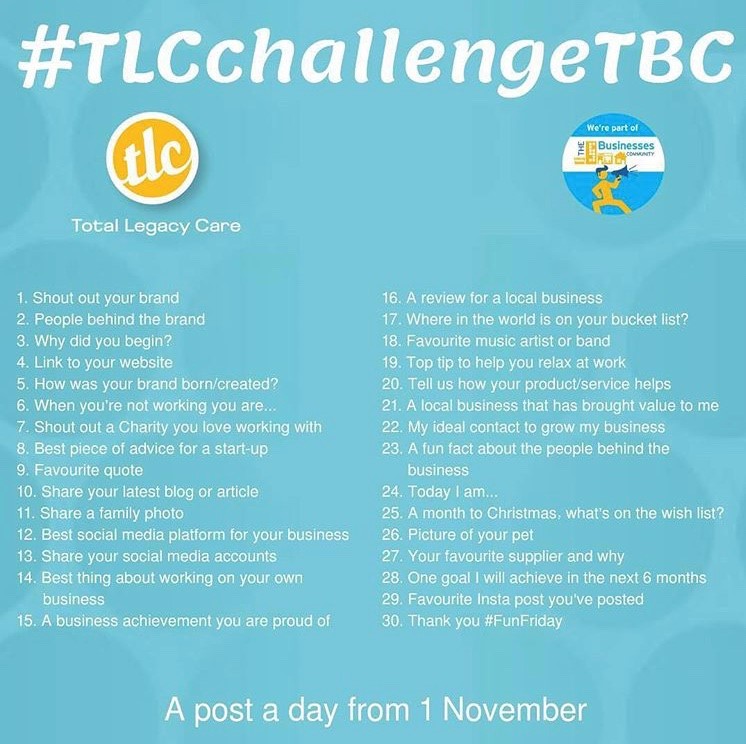
We have set out 30 days of content ideas below. So, look at the daily theme, put in about 30 minutes of planning time, snap some photos and get sharing across social media, simple right?

We will be using Instagram, Facebook and Twitter and will try and post early each day to give you all some ideas.

We would love as many businesses to join in as possible using the hashtags #TLCchallengeTBC and #SocialChallenge so that we can see all the posts and really get to know the people behind the business.

And, for those of you wondering…Why #TLCchallengeTBC?

We are part of an amazing online community bring businesses together – The Businesses Community  (definitely worth checking them out if you haven’t already!) – and we challenged them and all of their members to post on social media every day in November but why stop there? 

This is a challenge for everyone, so let’s do this!

~ Leah & Neil


Total_Legacy_Care_challenge_The_Business_Community_St_Albans
  1. Shout out your brand

  2. People behind the brand

  3. Why did you begin?

  4. Link to your website

  5. How was your brand born / created?

  6. when you are not working, you are…

  7. Shout out a Charity you love working with

  8. Best piece of advice for a start-up

  9. Favourite quote

  10. Share your latest blog or article

  11. Share a family photo

  12. Best social media platform for your business

  13. Share your social media accounts

  14. Best thing about working on your own business

  15. A business achievement you are proud of

  16. A review for a local business

  17. Where in the world is on your bucket list?

  18. Favourite music artist or band

  19. Top tip to help you relax at work

  20. Tell us how your product/service helps

  21. A local business that has brought value to me

  22. My ideal contact to grow my business

  23. A fun fact about the people behind the business

  24. Today I am…

  25. A month to Christmas, what’s on the wish list?

  26. Picture of your pet

  27. Your favourite supplier and why

  28. One goal I will achieve in the next 6 months

  29. Favourite Insta post you’ve posted

  30. Thank you #FunFriday

How I chose the guardians for my children…

How I chose the guardians for my children...

When choosing to put guardians in your Will what should you consider?

Often, when we are taking instructions from our clients, the conversation around putting guardians in place is one of the toughest.

For many, the main reason for getting their Will sorted is heavily influenced by who should look after their children if the worst happened. As a parent, it is especially hard to imagine someone else bringing up your children, nobody wants to think about what will happen if they are not around, but it is always worthwhile planning for and having measures in place should the tragic situation arise.

So, who is best to choose as guardians, what should you consider and how is best to tackle this difficult consideration and the conversation with your proposed guardians?

Using my own circumstances as an example, when I put my Will in place, I had to consider all of the following:


1)     Where would my children like to be (who with and location) if both of their parents were no longer around to look after them?


2)     Friends; I thought that during this tricky time of grief, my children would need to remain with as close to a normal routine as possible. Location was key to this so they can keep contact with friends, remain at a school they are familiar with, have family close to them and continue with clubs and activities they are used to and enjoy. This is not possible for everyone but was a consideration for me.


3)     Stability; choosing guardians that are able to look after my children until they are 18 and/or no longer need guardians was extremely important. Faced with the loss of their parents and moving in with guardians once is traumatic and I wouldn’t want this to happen again should their chosen guardians not be around until they reached an age they could live independently.


4)     The age of my proposed guardians; if the worst should happen now, it may be ok for my parents to cope with looking after my children, but what happens in 10 years’ time, will my parents be too old to cope or will it be too much for them?


5)     Am I burdening someone with the challenge of bringing up two (possibly additional) children?


6)     How will I finance my children through schooling and further education if I no longer had a regular wage coming in, I couldn’t expect someone to take on the responsibility of looking after my children and the added financial burden too?


All of these thoughts and worries ran through my head and I have always been a believer in the phrase “never ask someone to do something for you that you wouldn’t do in return for them”.

After careful consideration with my wife, we decided that the best person to be guardian of our children, should the circumstances occur, was my sister.

I wanted to have the conversation with my sister to ensure she was okay with this decision and once I had that conversation she was honoured and relieved that I had asked and had said that it was something that had been playing on her mind for a while but didn’t want to address it.

My sister also asked if I would be guardian to her children and this prompted her to put her Will in place soon after.

It was important to me to consider location; if my sister was a hundred miles away or even in a different country, would I have made the same decision? Probably not. Would I have wanted to put the burden on my parents? Would I look to a friend to be guardians of my children? There is a lot to consider all whilst bearing in mind what is best for my children. Then I had to consider reserve guardians, what if my sister was not willing to act if the time came, or she was no longer around. I went through the same considerations when putting my reserve guardians in place to cover this eventuality. 

One thing playing on my mind when I first began planning my Will and who I would appoint as guardians was, if I don’t plan, prepare and choose guardians, who will?

In circumstances where guardians have not been named in a Will, and no provision has been made for the children, the responsibility falls to the Local Authority to place children with guardians. The Local Authority have a duty to take care of the children’s best interests whilst making their decision, but this could take time and there is a possibility of being placed in temporary care whilst this process takes place. A harrowing thought that urged me to get my wishes written in my Will.

Like most of our clients, when I finally signed my Will, I felt a relief that despite what the future holds for me, I have taken the precautionary measures to ensure my children are looked after by the right people.

The lesson I learnt when dealing with this was that it’s always best to have these conversations and speak openly about your concerns. We managed to resolve two issues in one; guardians for both my children and my nephews.

I’m not saying that this is the solution for everyone and other family dynamics are different but, having these conversations are always worthwhile and ensuring that those people that you would like as your guardians understand the responsibility and are happy with the decision. 

 If you would like to discuss your Will and potential Guardians, call us on 01727 865 121 or email us at info@TotalLegacyCare.co.uk for a free discussion on how we can help.


Got a Question or want to book a FREE Consultation?

When should I make a Lasting Power of Attorney (LPA)?

When should I make a Lasting Power of Attorney?


Much like when deciding to make a Will (see our Article – When should I make a Will?), there is no right answer, to the question: when should I make an LPA? Everyone’s circumstances are different and so timing will be different for everyone. 


Everyone’s lives take different paths and at different ages and there is no one rule that will fit for all.


There are two types of LPA; a Property & Financial Affairs LPA which allows your Attorneys to make decisions in relation to your finances, bank accounts, stocks/shares, ISAs, your utilities as well as any property that you own or have an interest in, and a Health & Welfare LPA which allows your Attorneys to make decisions in relation to your health, medical treatment, day-to-day activities, living arrangements, accommodation and general welfare.


Below we have set out some of the milestones that making and reviewing your LPAs should be considered:


Recovering from an Illness or Injury

Ideally you would have an LPA in place to cover you prior to any incapacity (whether mental, physical or both) through illness or injury but should you not, it is extremely important to make this a priority once you have recovered.


Should anything happen subsequently, or completely separately, you will want to ensure that your loved ones can make decisions for you, on your behalf, if you are unable to without any hassle and delay. If you have already experienced a stint in hospital through illness or injury you will be all too aware of the delays that can be caused and the distress to loved ones through the lack of an LPA.


Once in a Lifetime Trip / Travelling

If you are embarking on a once in a lifetime trip or travelling it is important to consider an LPA. An LPA not only allows your Attorneys to
take decisions when you no longer have the capacity to do so but also if you are unable to because it requires you being physically present or a physical signature which may well be impossible if you are overseas, especially for an extended period.


Buying your first property

When most people buy a property it is usually their most valuable asset, so you need to prepare for this and ensure that someone that you trust is able to make decisions on your behalf if you are unable to do so through lack of capacity or because you are not contactable due to being abroad or in unforeseen circumstances.


Getting married

When you get married you may wish to review your LPA and consider who was appointed as your Attorney/s and whether this should be updated to include your spouse.


Having a baby

Whether you have your own children, are fostering or adopting, having a child  (or children!) changes your life and means that you are responsible for more than just yourself. It is important to have LPAs in place so that your loved ones can make decisions, without delay and without the expense of going through the Court of Protection, in relation to any health, welfare, financial or property decisions that may be required.


As your children get older you may want to consider appointing them as your Attorneys.


Attorneys must be over 18 years of age.


Buying a new or bigger property & Investing in buy-to-let
properties or second homes

When investing in more property you should also consider reviewing your LPAs, should you be unable to take decisions in relation to that property, either through lack of capacity or because you are not physically available or contactable, you need to ensure that someone that you trust implicitly is able to, and has the power to make such decisions.


Investing in assets abroad 

When you invest in assets abroad it is important that you are aware of the legal obligations in that country and whether you should be appointing an Attorney to deal with assets in that country.


Equally, if you decide to spend more of your time abroad then you may well have large periods of time that you are not in the UK and will be unable to make quick decisions or be available for signing of documents should it be required and so having an Attorney appointed that can do this on your behalf is important.


Getting divorced or Dissolving a Civil Partnership

If your spouse is appointed as your Attorney and you subsequently get divorced or the civil partnership is dissolved then the former-spouse will no longer be able to act as an Attorney.


It is important to review your LPA at this stage to ensure that you have replacement Attorneys in place or that new Attorneys are appointed.


Getting re-married

As we have set out above, when you get married, you may want to appoint your spouse as your Attorney (if you have not already done so) and so your LPA should be reviewed to ensure that the people you trust most with your affairs are appointed under the appropriate LPAs.


Owning a business

If you own a business you should consider our Article – Should I have a Lasting Power of Attorney in place to protect my business?


There may be circumstances in which you are unable to make commercial decisions and if that should happen, it may well be that the person that you would most trust to step into that position is unable to and powerless.


Depending on the setup of your business an LPA should be considered to assist with succession planning and setting out your business plan in order to limit disruption to your business and relieve those closest to you of the burden that comes with uncertainty and the possibility of making a Court of Protection application, avoiding any delays.


Retirement

This is another milestone where your circumstances change and you may well want to review and update who you have appointed as your
Attorneys. 


As set out above, you may be fortunate enough to spend some of you time once retired, abroad and so may well need Attorneys in place in the UK to take decisions for you when you are unable to or not available.


Ill or Poor Health

A Lasting Power of Attorney must be put in place whilst you have capacity and a Certificate Provider is required to certify this in order for the Power to be registered by the Office of the Public Guardian.


An LPA must therefore be put in place before your health deteriorates so much so that you lose capacity and are unable to obtain the signature of a certificate provider to register your Attorneys. Leaving an LPA too late can mean that you are unable to appoint those you want as your Attorneys and can mean a long and expensive court process for your loved ones.


An LPA can be revoked at anytime, Attorneys can be removed and new Attorneys appointed as and when you review your LPAs and any changes are required.


There is never a right time to put your LPAs in place but as you can see there are many milestones throughout your lifetime in which your LPAs may be required and so getting them in place early and keeping them under review throughout these milestones is important.


If you would like to discuss putting a Lasting Power of Attorney in place, call us on 01727 865 121 or email us at info@TotalLegacyCare.co.uk for a free discussion on how we can help.

Got a Question or want to book a FREE Consultation?