What to do after being diagnosed with Alzheimer’s Disease

What to do after being diagnosed with Alzheimer’s Disease

Whether receiving a diagnosis for yourself or a loved one, it is a very difficult time, so much information to take in and lots of changes on the horizon. It can be overwhelming.

Depending on where you are on your journey when the diagnosis takes place, may depend on the amount of information you already have and what is available.

Here we set out a simple list of steps that should be taken upon diagnosis to help you set off on the right path…

Total_Legacy_Care_Number_1

Knowledge is Power

You may have had experience with Alzheimer’s or Dementia before, or this may well be your first encounter, either way there may be symptoms that you are not aware of or have not experienced before.

The more you can learn the better. The phrase “forewarned is forearmed” comes to mind. The more we know, the better we can prepare.

There is a lot of support around online, groups, professionals, carers, families and individuals that have also been diagnosed all navigating a similar journey. Linking up with these groups and support can be beneficial mentally and emotionally.

Total_Legacy_Care_Number_2

Allow yourself to feel

As we have said, receiving a diagnosis for yourself or a loved one, is a very difficult time, so much information to take in and lots of changes on the horizon. Allowing yourself to go through the emotions you are feeling is okay.

You are not superhuman or a robot and taking time to acknowledge and process those emotions is invaluable.

There is no ‘correct path’ of emotions to take and so feelings of sadness, anger, frustration, disappointment and disbelief are all natural feelings.

Total_Legacy_Care_Number_3

Getting into a Routine

Getting organised and into a routine can really help, not only in terms of getting into good habits but to help set out early where everyone is, what should be done when and to know what is expected when. This is vital as the Alzheimer’s or Dementia progresses as routine and structure will be a necessity.

Alzheimer’s affects memory and so having a structured routine can help keep track of medication, appointments, activities and day-to-day tasks.

Routine can help to reduce stress, anxiety and frustration and increase independence and feelings of security.

Total_Legacy_Care_Number_4

Ensure your LEGAL and FINANCIAL affairs are in order

Managing your financial and legal affairs is impossible once capacity is lost. 

A diagnosis of Alzheimer’s or Dementia does not automatically mean that capacity is lost and so arranging the correct legal authorities are in place, whilst you have capacity to do so is vital.

You may consider reviewing your Will but also putting Lasting Powers of Attorney in place so that the person that you choose, and trust, has the authority to deal with your matters (financial, property, health and welfare) when you are no longer able to do so.  

We are always happy to have a free chat with you about this – CLICK HERE

Total_Legacy_Care_Number 5

Look at what CAN be done

Once a diagnosis is received is very easy to see this as a disabling disease that will only get worse and therefore discount capabilities, activities and all those things that were much loved prior to the diagnosis.

THIS DOESN’T HAVE TO BE THE CASE!

It is so important to consider what can still be achieved, the preferences, opinions and desires of the person living with Alzheimer’s.

A diagnosis doesn’t always mean that a person is incapable and they won’t necessarily lose their desire to carry out those activities that they used to love. Being able to carry this on for as long as is safe can be great for independence, self-esteem not to mention physical, emotional and mental wellbeing.

Total_Legacy_Care_Number_6

Consider a Care Plan

It is inevitable that as the Alzheimer’s or Dementia progresses the need for care will increase, as will appointments with an array of professionals.

There may be a range of people helping with care, loved ones, family, friends and professionals, and a care plan can assist with setting out who is responsible for what, what is expected and when this is expected.

Having a plan for now, as well as having discussions about what may be needed as the condition progresses, and how this could be catered for can save a lot of stress in the future.

Total_Legacy_Care_Number_7

Diagnosis is NOT the End

It is natural to feel that there is no light at the end of the tunnel or struggle to see what there is to be grateful for when receiving a diagnosis of Alzheimer’s or Dementia as the road ahead can seem somewhat bleak and overwhelming however, this doesn’t have to be the case.

Taking into account point 5 above and looking at what can be done means that it is not the end…fun can still be had, knowledge can still be gained and relationships can still develop. 

Yes, things will be different but that does not mean it has to be worse.

Total_Legacy_Care_Number_8

You are NOT alone

Remember, whether you are the one that has been diagnosed, a loved one or caregiver…you are NOT alone.

There are lots of support groups out there, those that you can attend locally and National support groups that you can access online.

We have a list of upcoming events that maybe local to you on our website HERE.

There are no stupid questions and so we should not be afraid to ask for help or assistance.

Everyone’s journey is different, neither right nor wrong. We all have different experiences and can learn something new.


If you would like a free chat to see how we can help or if you have any questions please do not hesitate to get in touch for a FREE consultation on info@TotalLegacyCare.co.uk or 01727 865 121

Dementia TLC

Did you know we have a whole website dedicated to Dementia, those living with Dementia and their Caregivers?

Check it out HERE!

Leah Waller

Have a Question or
want to book a 

FREE Consultation?
 

How to Solve a Rubik’s Cube: What’s the Link?

How to Solve the Rubik’s: What’s the Link?

Rubik’s Cubes and Total Legacy Care…what is the link?

This is something that we are SO SO passionate about so, let us enlighten you!

As a legal firm, we protect our clients with Lasting Powers of Attorney but we wanted to do something to go the extra mile for our clients. That’s when we decided to help our clients to not only protect themselves if they were to lose capacity in the future, by putting Lasting Powers of Attorneys in place, but ensure they take measures to keep their minds active and have some fun in the process. Learning to solve the Rubik’s Cube has some amazing benefits…

The Rubik’s Cube is often referred to as the IMPOSSIBLE TOY but everyone recognises the iconic cube and it often brings back memories from childhood, whether that be elation at solving the cube or frustration at not being able to!

We are so passionate about the positive benefits that the Rubik’s Cube can have that we have committed to giving each of our clients a Rubik’s Cube when we have finished registering their Lasting Powers of Attorney BUT WHY?

The Rubik’s Cube is not only for the younger generations but for ALL of us! Some of the benefits that we have already seen from our voluntary projects include; improved dexterity and coordination, memory improvement as well as a reduction in anxiety, getting social, engagement and socialising with others (and maybe even those that you wouldn’t usually!).

So, what exactly do TLC do?

Not only are we great believers in the positive benefits of the Rubik’s Cube at any age, we are always keen to HAVE FUN!

We give a Rubik’s Cube to each client upon registration of their Lasting Powers of Attorney and have just finished recording our videos that will teach YOU how to solve the Rubik’s Cube in just EIGHT steps! 

A Lasting Power of Attorney in relation to your Health and Welfare only comes into effect when you have lost capacity (either physically or mentally,  or both) and are unable to make decisions for yourself, whereas a Property and Financial Affairs Lasting Power of Attorney can come into effect immediately upon registration or upon losing capacity, depending on your decision. So, here at TLC we don’t just want to help you in the future…we want to help you now! Hence the Rubik’s Cube. We genuinely believe that the positive benefits of the Rubik’s Cube, learning to solve it and keeping your mind active each day will have lasting effects on your health and wellbeing going forward and so that is our gift to you.

We currently run projects throughout Care Homes and Day Centres to teach people, largely the older generation (we are talking 30plus, so definitely not old!), how to SOLVE THE RUBIK’S CUBE.

We have taken solving the Rubik’s cube and simplified it to open it up to all ages and abilities. Through trial and error, and with the help of a group of elderly participants, we have devised a course of eight sessions with simple videos to accompany them. The videos will be released on FRIDAY 25 OCTOBER and will be available on our website and on YouTube (so, keep your eyes peeled).

Our main aim is to HAVE FUN but solving the Rubik’s Cube keeps the mind active and has already demonstrated that is is key in helping the residents within a Care Home or Day Centre setting to learn (or re-learn) a skill – solving the Rubik’s cube, whilst having the benefits of improving their hand-eye coordination and giving them something a bit different from the norm.

We are keen to explore a link between solving the Rubik’s Cube and stimulating and improving short-term memory (similar to those studies with Sudoku, Crosswords and chess), a symptom of Dementia that is common across most types of the condition. Keeping the mind active has numerous benefits and can keep connections within the brain communicating to improve a person’s daily activities and communication skills.

At present we are often found in Care Homes and Day Centres teaching our lessons on how to solve the Rubik’s Cube, we are currently in talks with an Autism Charity to develop a scheme for them too as the benefits for those with Autism could be just as positive and rewarding!

This is a project we are super passionate about and are always happy to discuss.

If this is something that you would be interested in for yourself,or a group that you are involved in or just want to have a chat or find out more, please do GET IN TOUCH!

And, if Lasting Powers of Attorney is something that you have been thinking about, or putting off, now is a great time to get your plans in place!

Before we go…

We couldn’t write an article about this without mentioning our latest involvement with Rubik’s:

🏆GUINNESS WORLD RECORD🏆

We are so proud to be a part of the Guinness World Record for… 

The most contributions to a Rubik’s Mosaic. With 308 individuals contributing to the final mosaic, it was a brilliant achievement!

Rubiks_Prince_Harry_Mosaic

Thank you so much to Rubik’s Brand Limited and Torgeir Amundsen (Cube Arting) and CONGRATULATIONS!


We absolutely LOVE teaching all generations how to solve the Rubik’s Cube and it was our pleasure to help as many as we could to be involved in the GUINNESS WORLD RECORD! 🧡

Rubiks_Guinness_World_Record
Rubiks_Guinness_World_Record_Mosaic

Solving the Rubik’s Cube has so many POSITIVE BENEFITS!


If you would like more information, to discuss a project with 

a group you are involved with, 

or are thinking about putting Lasting Powers of Attorney in place, 

call us on 01727 865 121 or email us at info@TotalLegacyCare.co.uk

Leah Waller

Have a Question or
want to book a 

FREE Consultation?
 

Wouldn’t it be great if we could predict the future?

Wouldn't it be great if we could predict the future?

We all have busy lives and so sometimes just predicting what today is going to ring is an achievement, let alone way into the future! It would be great though, wouldn’t it 😉

Unfortunately, none of us know what is just around the corner and so planning for it is key. That is where Lasting Powers of Attorney (LPAs) come in! LPAs are relevant during your lifetime and ensure that someone that you trust and have appointed as your Attorney can act on your behalf when you are unable to. Check out our article, Why Do YOU need an LPA? 5 reasons YOU should put your LPA in place for more information on LPAs.

We all know that age is going to hit us hard at some point but that ‘point’ is way off in the future, right? Unfortunately, this may not be the case…

Just looking at a few celebrities, we can see that an LPA may be needed a lot sooner than we would have hoped!

Chris_Tarrant

Chris Tarrant was just 67 years of age when he suffered a stroke that led to an emergency operation and ongoing rehabilitation to help him to regain his speech and physical movement.

Michael_Schumacher

Michael Schumacher was only 44 years old when a skiing accident resulted in him being placed into a medically induced coma (for six months!) and suffering life-threatening head injuries. 

Micahel Schmacher is a father of two children, who were aged just 14 and 16 at the time of the accident.

Richard_Hammond_Top_Gear

Richard Hammond was involved in an awful car accident whilst filming for Top Gear at the age of just 37 causing major brain damage after being in a coma for two-weeks, this also led to significant memory loss and depression.

However, it is not just celebrities that this happens to and when we take a look at the facts, they are hard-hitting! Just a couple of statistics for you:

  • Every 90-SECONDS, someone in the UK is admitted to hospital with a brain injury;
  • Every THREE-MINUTES, someone in the UK is diagnosed with Dementia (and this is not just a condition that affects those over 65!);
  • Every FIVE-MINUTES, someone in the UK suffers from a stroke;
  • One in Six people within the UK will have a stroke during their lifetime;


So, enough of the doom and gloom….

What can we do to ensure we are protected, plan for our future and our family’s future and give us some much needed peace of mind?

The answer is a simple one…. Get your Lasting Powers of Attorney in place whilst you still have capacity to do so!

There are two types of Lasting Power of Attorney:

  • Health & Welfare Lasting Power of Attorney; and
  • Property & Financial Affairs Lasting Power of Attorney.

(to find out more about these check out our article Why do I need an LPA?)

An LPA allows you to appoint an Attorney, or Attorneys, to make decisions for you, and on your behalf when you are unable to. This could just be a temporary measure due to a temporary loss of capacity either physically or mentally or a more permanent arrangement.

You can give your Attorneys guidance and state your preferences, should you choose to do so, within your LPAs and set out the extent of the power that you want your Attorneys to have.


So, what if you don’t get around to getting these all important LPAs in place?

If you do not  register LPAs whilst you have the capacity to do so then you lose control to a certain extent as it is then for your loved ones, or a professional, to apply to the Court of Protection for a Deputyship Order in order to manage your financial affairs on your behalf. 

This process is costly – a court fee of £385, not to mention legal fees if you seek legal advice and potentially a fee for a professional to verify your lack of capacity to support the application being made, and timely – the application can take around 4 months to be granted from the date of submission however, if there are objections made to the application then this process can take 9-12 months!

Once you have lost capacity you lose the ability to choose who you want to appoint to manage your affairs for you and ultimately the choice is left to the Court of Protection – this may not be who you would have chosen had you been able to make the choice yourself. 

You also lose the opportunity to give guidance to your appointed Attorneys and advise of your preferences.

In relation to your health and welfare, if you do not make an LPA to cover this whilst you have the capacity to the Court of Protection will be reluctant to appoint a Deputy in relation to your healthcare decisions unless the circumstances are extremely complex. Again, meaning you lose the control to appoint who you trust to make decisions on your behalf.

Getting an LPA in place doesn’t have to be complicated, time consuming or expensive and can ensure that you have peace of mind and take the burden away from those closest to you.


If you would like a free chat to see how we can help or if you have any questions please do not hesitate to get in touch for a FREE consultation on info@TotalLegacyCare.co.uk or 01727 865 121

Leah Waller

Have a Question or
want to book a 

FREE Consultation?
 

What to consider when Inheriting

What to consider when Inheriting

Mandy Rodgers is a Wealth Manager with St. James’s Place Wealth Management and has kindly put together the following considerations that you should have a think about when receiving an inheritance…

Mandy_Rodgers
Mandy Rodgers

Receiving an inheritance can generate mixed feelings – sadness that a loved one has passed away, possibly relief that maybe some debts can be paid off, or uncertainty over how best to make use of your inheritance in your lifetime whilst ensuring there’s something left to pass down to future generations.

Receiving an inheritance may be the first time you’ve had to worry about investment options and can be quite daunting if that’s not something you have experience of. There is no one right answer as everyone’s circumstances are different, but some things to consider are…

  • Paying off any expensive credit cards & store cards first
  • A lot of mainstream mortgages today are at very competitive interest rates, around the c. 2% mark, so it wouldn’t necessarily make sense to pay down a mortgage as your money could be put to better use depending on your attitude to investment risk & return. 

For some people, they just want to know the mortgage is gone and paid off. For others, if the mortgage payments are affordable and they’re happy the mortgage will be paid off before retirement they might prefer to invest their inheritance elsewhere to potentially  generate capital growth… or maybe a middle option would suit, where they could pay off a lump sum (to reduce the monthly mortgage payments or reduce the mortgage term) and invest the rest (take proper advice on your situation, and check with your lender first to see whether early repayment charges apply)


  • One thing’s for sure, with cash savings interest rates at a fraction of 1% and inflation at c. 2%, money held in cash will go backwards in real terms, so that’s probably not the answer
  • Many people have in the past opted for ‘bricks & mortar’, and have bought Buy to Let properties. Whilst property has been a good performing asset class the tax rules around second properties have become particularly punitive and so on its own, residential property is becoming less attractive. Coupled with the fact that it brings with it the hands on hassle of dealing with tenants, and managing repairs & maintenance (which are often underestimated), it’s not always the ‘passive’ investment it’s thought to be


I work with clients to provide professionally managed and well diversified investment options that suit their personal circumstances and objectives. These are tailored to their attitude to risk and regularly reviewed and managed by me to form part of their overall financial life plan. Using the most appropriate investment tax wrappers is also important, to ensure everything is as tax efficient and admin easy as possible during your lifetime, and will pass down to the next generation as tax efficiently as possible too. If you’ve had to pay Inheritance Tax on your inheritance, you’ll understand the importance of timely tax planning!

The key point is to get some proper financial advice and look at options that work for you and your situation. Unless you’re familiar with the financial industry there’s every chance you 

‘don’t know what you don’t know’

and a professional can inform you and guide you through the options to make the best decision for you and your family.

Mandy_Rodgers

If you would like to discuss your financial situation / inheritance, contact…

Mandy Rodgers 

07824 408990 


mandy.rodgers@sjpp.co.uk

The value of an investment with St. James’s Place will be directly linked to the performance of the funds you select and the value can therefore go down as well as up. You may get back less than you invested.  An investment in equities does not provide the security of capital associated with a deposit account with a bank or building society.

The levels and bases of taxation and reliefs from taxation can change at any time. The value of any tax relief depends on individual circumstances. 

The Partner Practice is an Appointed Representative of and represents only St. James’s Place Wealth Management plc (which is authorised and regulated by the Financial Conduct Authority) for the purpose of advising solely on the group’s wealth management products and services, more details of which are set out on the group’s website www.sjp.co.uk/products. The ‘St. James’s Place Partnership’ and the titles ‘Partner’ and ‘Partner Practice’ are marketing terms used to describe St. James’s Place representatives.

Leah Waller

Have a Question or
want to book a 

FREE Consultation?
 

What happens without a Lasting Power of Attorney?

Court of Protection:
What happens without a Lasting Power of Attorney?

So, we tell you all the time how important WE think it is to have an LPA in place and it is never too early (once you’ve hit 18 of course!) to get one in place, BUT WHY?

Well, put simply if you don’t have a Lasting Power of Attorney in place and you lose capacity or are unable to make decisions for yourself (whether temporarily or on a more permanent basis) then you will need to have a Deputy appointed by the Court…as you can imagine, this is not a quick process nor is it cheap!

So, let’s take a look at exactly what is involved in obtaining a Deputyship Order, what it means and how you can ensure you are covered.

Just in case you have missed our other articles on Lasting Powers of Attorney (LPAs); there are two types of LPA, one to cover your property and financial affairs and another that will cover your health and welfare decisions. An LPA can only be put in place by you when you have capacity to do so to allow someone to act for you, step into your shoes if you like, when you are unable to do so. The property and financial LPA can be used by your Attorney (if you want them to) at any time after it has been registered, not just when you lose capacity!

No_LPA

However, what happens when you haven’t yet got around to putting an LPA in place and you lose capacity? 

Well let’s take a look at what happens to your property and financial affairs first…

An application will need to be made to the Court of Protection to appoint a Deputy to look after and manage your finances and property, once you have lost capacity and are unable to do so, BUT…

Once you have lost capacity, you also lose the THE CHOICE of who you want to handle your property and financial affairs.

Once you have lost capacity, it is for the Court of Protection to decide who is best to handle your affairs for you…this may not be the person that you would have appointed.

The Court of Protection will choose a Deputy that they think is suitable to manage your affairs and although your past and present feelings may be taken into consideration this is difficult once capacity is lost.

It will be down to your loved ones to apply to the Court of Protection for the Deputyship Order and this can be a huge burden that you wouldn’t want anyone to endure, let alone those closest to you.

The list of those eligible to apply for a Deputyship Order is quite extensive and includes one of your relatives, a close friend, a professional or anyone that has an interest in you and your affairs. However…this doesn’t change the fact that you have no control over this and that you are leaving it up to one of your loved ones to make the application and for the Court to decide whether they are deemed suitable to act as your Deputy.

The power that the Court appointed Deputy has will be limited to what is stated within the Deputyship Order. This may not be as far reaching as an LPA would allow and so it may well be necessary to return to Court to have this extended.

An LPA allows you to set out any restrictions, preferences and guidance that you want to leave for your appointed Attorneys, you will be unable to do so in a Deputyship Order.

To make the application to the Court of Protection, a fee of £385 (current rate in 2019) is also payable to the Court. 

This does not include any legal fees and so if you seek legal advice or assistance in completing and submitting application, this will be an additional cost.

There may also be fees that are payable to the professional that has to verify that you no longer have capacity and thus require a Deputy to be appointed.

In addition to this, there are annual fees payable to the Court of Protection for Deputyship Orders.

As you can imagine, some of the decisions in relation to your financial affairs are pretty time sensitive. However, an application for a Deputyship Order usually takes 3-4 months to be made, from the date that the application is submitted. This is where there are no objections to the application, this can be much longer, and very different, if any objections are raised.

Where objections are raised and the matter has to be heard before a Judge, the process can take nine months or longer to conclude

For Health and Welfare matters, things are a bit more complex.

If you have not made an LPA in relation to your Health and Welfare prior to losing capacity then it is quite rare for the Court of Protection to appoint a Deputy for you in relation to these matters.

An application can be made, again to the Court of Protection, in much the same way as it is made for a Deputyship Order in relation to your property and financial affairs but are usually only appointed in complex circumstances.

Again, meaning that you lose the control and choice to appoint who you want to be able to make those decisions on your behalf and also lose the ability to put preferences and guidance in place for your Attorneys to take the decisions that you would have made had you been able, and had the capacity, to do so.

THE PROCESS…

Let’s take a brief look at the process for applying for a Deputyship Order for those situations where an LPA hasn’t been registered prior to losing capacity.

We briefly mentioned (above) that the list of those that are eligible to make the application for a Deputyship Order is quite extensive, but in order to be successful, the applicant will need to show that they have a good knowledge of your finances and property affairs and will also have to demonstrate, with verification from a professional, that you no longer have capacity to make decisions in relation to your own financial and property matters.

Upon making the application to the Court of Protection a Court Fee of £385 Present 2019 rate) is also payable, whether successful or not. An additional fee may be charged by the professional that verifies your capacity. If the applicant seeks legal advice and assistance in completing and submitting the application to the Court of Protection, this will incur additional fees. 

There are also ongoing fees, paid annually, to the Court of Protection in relation to Deputyship Orders that are made.

The application will then be accepted and issued by the Court of Protection and the applicant will need to serve a copy of the application on all those that they believe have an interest in the application being made and those directed by the Court and within the Court Guidance (known as the Respondents).

The Respondents are then given an opportunity to respond to the application.

If no objections are received to the application from any of the Respondents then the Court of Protection will make a Deputyship Order and this is usually done within four months of the application being submitted.

However, if any objections are received then a Hearing will be listed in front of a Judge to consider the matter and the objections. This will not only delay the Deputyship Order being made but will also increase costs as it is likely that legal representation and advice will be required. The time and expense will differ depending on the number of parties involved and the number, nature and complexity of the objections.

If you have any questions please do not hesitate to get in touch for a FREE consultation.

If you would like a FREE chat to discuss your options, get in touch on info@TotalLegacyCare.co.uk or 01727 865 121

Leah Waller

Have a Question or
want to book a 

FREE Consultation?
 

LPA Certificate Provider

LPAs: Who can be my Certificate Provider and what is their role?

Getting a Lasting Power of Attorney (LPA) in place for your Health & Welfare and your Property & Financial affairs is SO important and can be a relatively stress-free and quick process but you will need a Certificate Provider…

So, what is a Certificate Provider, what do they do and why are they needed?

Certificate_Provider

Well, in order to register your LPA you will need a Certificate Provider to sign the LPA application to certify that you have the capacity to make the application and that you understand the extent of the power that you are giving to your appointed Attorney, or Attorneys.

In order to do this, the Certificate must have knowledge of the TWO-STAGE TEST FOR MENTAL CAPACITY and make a judgement as to whether you (the person applying for the LPA) can understand the information that is relevant to making the decisions within the LPA, whether they are able to retain that information and weigh up the information in order to make a decision and communicate that decision.The Certificate Provider must also be aware of the FIVE PRINCIPLES OF CAPACITY:

You are assumed to have capacity UNLESS it can be established that you do not.

You are to be treated as though you can make decisions UNLESS all practicable steps have been taken to help you make a decision and all have been unsuccessful.

Just because you make an unwise decision it does NOT mean that you lack capacity.

Any decision taken MUST be done or made in your BEST INTERESTS.

PRIOR TO ANY DECISION, consideration must be given to whether it is effectively achieves the purpose in the least restrictive way to your rights and freedoms.

So, who can be a Certificate Provider?

A Certificate Provider must be either:

Professional_Certificate_Provider

A PROFESSIONAL CERTIFICATE PROVIDER can be someone over the age of 18 that has the necessary knowledge and experience, because of the skill and profession, to make a judgment as to your capacity.

Frequently used Professional Certificate Providers include, US here at TLC, Solicitors, Estate Planners, Legal Professionals, GPs, Medical Professionals and Social Workers.

Personal_Certificate_Provider

A PERSONAL CERTIFICATE PROVIDER can be someone that is over the age of 18 and has known you for at least two years prior to the date on which you apply to register your LPA.

This person will need to be someone that can have a full and frank discussion with you about your capacity and your understanding of the LPA and the consequences of registering such a document.

Who CANNOT be your Certificate Provider?

Your Certificate Provider cannot be under the age of 18.

Your Certificate Provider cannot be one of the people that you have appointed as your Attorney in the LPA you are applying for.

Your Certificate Provider cannot be one of the people that you have appointed as a replacement Attorney in the LPA you are applying for.

Your Certificate Provider cannot be one of your family members (this includes your boyfriend/girlfriend, partner,  in-laws and step-relatives).

Your Certificate Provider cannot be a family member of the appointed Attorneys (this includes their boyfriend/girlfriend, partner, in-laws and step-relatives).

Your Certificate Provider cannot be your Business Partner.

Your Certificate Provider cannot be your appointed Attorneys’ Business Partner.

Your Certificate Provider cannot be your employee.

Your Certificate Provider cannot be an employee of your appointed Attorneys.

Your Certificate Provider cannot be someone that works for a Trust Corporation that is appointed as your Attorney.

Your Certificate Provider cannot work for the Care Home where you live (if you reside in a Care Home), or a family member of someone working for the Care Home. This includes the owner, manager, directors, staff and employees.

What next?

Once the above has been satisfied, the Certificate provider will sign and date the LPA application and confirm that you understand the LPA, its purpose and consequences, that you are under no undue pressure or influence to sign the LPA, that no act of fraud is being committed and that there is nothing that would prevent that LPA from being registered by the Office of the Public Guardian.


If you have any questions please do not hesitate to get in touch for a FREE consultation.

If you would like a FREE chat to discuss your options, get in touch on info@TotalLegacyCare.co.uk or 01727 865 121

Leah Waller

Have a Question or
want to book a 

FREE Consultation?
 

Bank of Mum & Dad

Bank of Mum & Dad:
The implications of helping the younger generation getting on the property ladder

Helping the younger generation to get an all important foot on the property ladder may be the only option for many parents but what should we, as parents, consider before shelling out the deposit?

LPA_Gift

Perhaps the simplest way to help the younger generation in getting a foot on the property ladder, is by giving them a decent sized deposit as a GIFT. There are no tax implications on this gift of money, as parents can pass money (as much as they like!) to their children without incurring any tax liability.

However, if you (the parent) pass away within seven years of making the gift then it may be subject to Inheritance Tax. Where your Estate is worth more than £325,000 (the current Inheritance Tax Threshold) Inheritance will be payable on everything over this amount, including any gifts given within the seven years prior to your death.

Where money is gifted and the property is being bought by your child with a partner, it may be worth considering what would happen should the relationship between your child and their partner take a downturn and the property ultimately be sold.

LPA_Loans

Possibly a better option for parents not in a position to give an outright gift, is to LOAN your children the money for a deposit.

However, some mortgage companies may not be prepared to enter into arrangements where money has been loaned and so this could limit the mortgage options. Where a mortgage company is happy to accept the arrangement, they may want to know the exact repayment arrangements in order that these can be taken into account when calculating the mortgage and affordability and therefore meaning that a lower amount can be borrowed.Where you have loaned the money and receive repayments, you may be liable to Income Tax on any interest that you charge on the loan amount (if any interest is charged).

If you are going to loan the money, then it would be worthwhile drawing up a formal loan agreement to include all of the agreed terms in relation to repayment, any interest and the expectations of each party.

LPA_Buy

Another option would be for you to BUY THE PROPERTY with your child. You could purchase the property as TENANTS IN COMMON to reflect the amount of the property that is owned by each individual (perhaps dependant on the amount that you are putting into the property and how the mortgage will be paid).

However, if this means that you would own more than one property then it will count as a second home and you would therefore be liable to an additional 3% on Stamp Duty and may also have Capital Gains Tax implications when the property is sold if you are still listed on the property as an owner/proprietor at Land Registry or on the mortgage.

If this option is taken, it would be advisable to draw up a Declaration of Trust to include the proportions owned by each person and what happens if one party wants to sell.


So, although helping your children take that all important step to get on to the property ladder may seem like a great idea, it is extremely important to think about the best way of doing this…for yourself and for your children!


If you would like a FREE chat to discuss your options, get in touch on info@TotalLegacyCare.co.uk or 01727 865 121

Leah Waller

Have a Question or
want to book a 

FREE Consultation?
 

Rubik’s Cube & TLC: What is the connection?

Rubik’s Cubes & TLC:
What is the connection?

What on earth is the connection between a Will Writing Company and Rubik’s?

It does seem a little random doesn’t it?

Well let’s clear this up for you…

Rubiks_Speed_Cube

Here at TLC, one of our core services is putting Lasting Powers of Attorney in place for our clients. Our clients are concerned about losing capacity later in life and want to make sure they are covered – It’s very important, and you can find out more in our article “Why do I need an LPA?”.

One of our clients’ main concerns, when considering an LPA, is developing Dementia; a cruel condition that takes over an individual’s life. Like many of us, we at TLC have had loved ones that have developed this condition and have first hand experience of the devastation it can bring. We wanted to look at ways of preventing or at least delaying the symptoms of Dementia.

Dementia is classed as a “disease of the mind” and affects the brain. Memory loss is a significant symptom and so we were keen to look into this. Research and studies have shown that keeping the mind active has positive benefits at any age and this can take a variety of forms including completing crosswords, sudoku and such like, to improve their minds and keep them active. So, we thought, let’s up the ante a little and look at one of the most difficult puzzles of all time…the Rubik’s cube. 

One of the directors at TLC is a Rubik’s fanatic (that’s me!), not least because having learnt with my son just a few years ago, I know of the huge benefit that the Rubik’s cube brought, enabling bonding with my son as we learnt to solve it.

When you look at a cube for the first time, it seems utterly impossible. There are books to read to solve it, videos on YouTube but even these seem confusing and overwhelming. We persisted, took each stage onboard and finally completed it! It took a little while to continue to practise until we were confident to complete it, on our own, unaided. At the age of 40, I felt like I had really achieved something but the time with my son learning together was PRICELESS!

I still solve the Rubik’s cube daily and not a day has passed, since I learnt the cube three years ago, that I haven’t picked up my cube and played around with it.

Still with us? Let’s continue.

Now, the benefits alone from the Rubik’s cube can make your mind sharper, it builds your own confidence and raises self esteem, improves hand-eye coordination just to mention a few. These benefits can make a huge improvement on someone’s day-to-day life and so this is why we decided to take the Rubik’s cube into care homes.

Rubik's_At_Care_Home

We took some time to devise lessons specifically tailored to the elderly – this was never, and will never be, about speed rather just about being able to solve the cube, as that in itself is a feat! 

We broke the course down into 8 steps to be able to complete the Rubik’s cube (from wherever you start with the cube). Each week we teach a step towards solving the Rubik’s cube.

Each step takes around 2 minutes to explain, then we practice, practice… and practice some more!!! Our participants love it, as do we. Seeing their faces light up as they understand and get what they are doing is rewarding in itself. There is a buzz in the room…there’s also confusion at times, but we work passed that 🙂

Rubiks_At_The_Care_Home

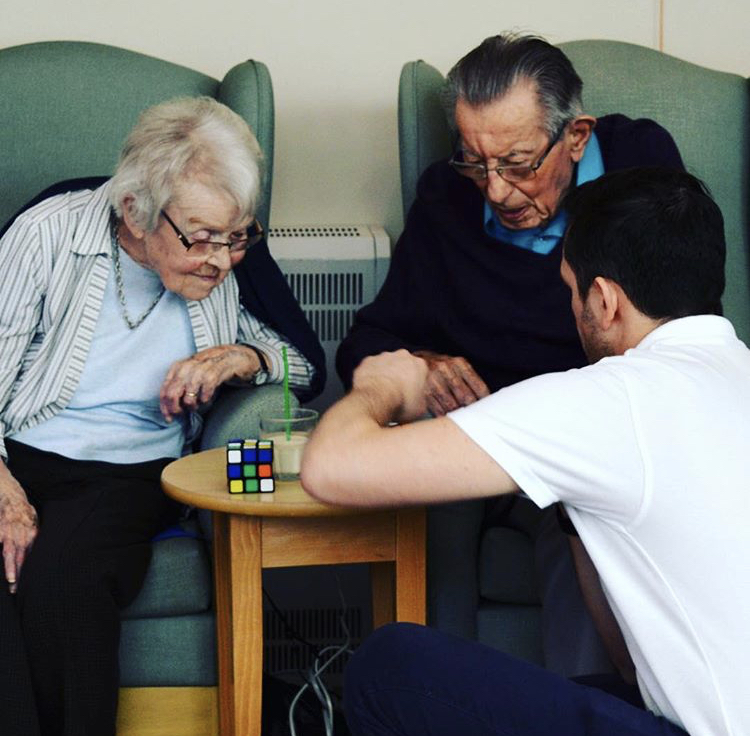
One of our current students is 101 years young and an absolute inspiration, she is so focused on learning and mastering the Rubik’s cube and is always the first in the class and the last to leave.

We are currently working with a fantastic Care Home in St Albans – Grace Muriel House, which is a fabulous care home with wonderful staff. The carers sit in on the lessons as the residents learn and able to support the participants in the lessons and then throughout the week once we have left. This project is supported by Rubik’s themselves and they have provided all of the Rubik’s cubes free of charge for everyone to learn – 

Thanks Rubik’s for your support!

Chick_Rubiks

We are now running a project to prove the cube can make a difference and hopefully delay the effects of Dementia. We also have a separate social media account & website  http://DementiaTLC.co.uk to provide awareness and support to those living with the condition and also carers and family members.

English_Bulldog_With_Rubiks
French_Bulldog_with_Rubik's_Keyring

If you would like to learn to solve the cube yourself or want to get involved with our volunteering, please do get in touch.


info@TotalLegacyCare.co.uk or 01727 865 121

Neil Barras-Smith

Have a Question or
want to book a 

FREE Consultation?
 

Why Do YOU need an LPA? 5 reasons YOU should put your LPA in place

5 reasons
YOU should put your
LPA in place

You will know by now that here at TLC we are passionate about EVERYONE having Lasting Powers of Attorney in place! Contrary to popular belief they are not just something that should be considered as we get older.

So, we have set out below our FIVE top reasons for getting your LPAs in place. This is, of course, just the tip of the iceberg and there are many many more reasons but these should be enough to prompt you…

LPA_Peace_Of_Mind

Having PEACE OF MIND is paramount.

Knowing that all of your property & financial affairs and your health & welfare decisions are in order and can be dealt with by your Attorneys, should you be unable to do so – whether that be because you are physically unable to or because you lack the capacity to do so – will not only put your own mind at ease but will also remove the emotional and financial burden from your loved ones should the situation arise that your LPA is needed.

Taking the decision to put your Lasting Powers of Attorney in place means that you have the control.

YOU DECIDE who you want to appoint as your Attorneys (and can also appoint replacement Attorneys). 

If you do not put LPAs in place and your loved ones/caregivers are put in a situation where an application has to be made to the Court of Protection to appoint a Deputy to make decisions on your behalf, then the Court will decide who to appoint and this may not be the person/people that you would have chosen.

LPA_Your_Choice
LPA_Give_Specifics

Putting your LPAs in place means that you are able to GIVE SPECIFICS not only as to who you want to appoint as Attorneys but also in relation to how they will act; whether they can take decision on their own or whether decisions must be made unanimously by all Attorneys, or perhaps some decisions are to be taken by a specific Attorney or unanimously – this can all be provided for.

Your LPAs will also state when they can be used, whether this will be immediately or only when you lose capacity to make decisions.

You can also state your preferences and put in any restrictions that you want your Attorneys to abide by, giving you the ultimate control and peace of mind.

Putting your Lasting Powers of Attorney in place and getting them registered whilst you still have capacity is so important – TIME IS OF THE ESSENCE.

You are unable to register your LPAs once you have lost capacity and so your loved ones/caregivers will have to make an application to the Court of Protection to appoint a Deputy to make decisions on your behalf, then the Court will decide who to appoint and this may not be the person/people that you would have  chosen. This process will take a minimum of four months – all whilst important (and urgent!) decisions cannot be made.

LPA_Time
LPA_Costs

The COSTS of putting Lasting Powers of Attorney in place pale into insignificance compared to the costs involved in making an application to the Court of Protection to appoint a Deputy to make decisions on your behalf. The application fee for the Court of Protection is currently £385 and this does not include any legal costs involved in drafting, finalising and lodging the application nor dealing with any questions or possible  objections.

The office of the Public Guardian charges a fee of £82 to register each LPA and each individual should register two LPAs – Health & Welfare and Property & Financial Affairs.

If you have any questions please do not hesitate to get in touch for a FREE consultation.

If you would like a FREE chat to discuss your options, get in touch on info@TotalLegacyCare.co.uk or 01727 865 121

Leah Waller

Have a Question or
want to book a 

FREE Consultation?
 

5 reasons
YOU should put your
LPA in place

You will know by now that here at TLC we are passionate about EVERYONE having Lasting Powers of Attorney in place! Contrary to popular belief they are not just something that should be considered as we get older.

So, we have set out below our FIVE top reasons for getting your LPAs in place. This is, of course, just the tip of the iceberg and there are many many more reasons but these should be enough to prompt you…

LPA_Peace_Of_Mind

Having PEACE OF MIND is paramount.

Knowing that all of your property & financial affairs and your health & welfare decisions are in order and can be dealt with by your Attorneys, should you be unable to do so – whether that be because you are physically unable to or because you lack the capacity to do so – will not only put your own mind at ease but will also remove the emotional and financial burden from your loved ones should the situation arise that your LPA is needed.

LPA_Your_Choice

Taking the decision to put your Lasting Powers of Attorney in place means that you have the control.

YOU DECIDE who you want to appoint as your Attorneys (and can also appoint replacement Attorneys). 

If you do not put LPAs in place and your loved ones/caregivers are put in a situation where an application has to be made to the Court of Protection to appoint a Deputy to make decisions on your behalf, then the Court will decide who to appoint and this may not be the person/people that you would have chosen.

LPA_Give_Specifics

Putting your LPAs in place means that you are able to GIVE SPECIFICS not only as to who you want to appoint as Attorneys but also in relation to how they will act; whether they can take decision on their own or whether decisions must be made unanimously by all Attorneys, or perhaps some decisions are to be taken by a specific Attorney or unanimously – this can all be provided for.

Your LPAs will also state when they can be used, whether this will be immediately or only when you lose capacity to make decisions.

You can also state your preferences and put in any restrictions that you want your Attorneys to abide by, giving you the ultimate control and peace of mind.

LPA_Time

Putting your Lasting Powers of Attorney in place and getting them registered whilst you still have capacity is so important – TIME IS OF THE ESSENCE.

You are unable to register your LPAs once you have lost capacity and so your loved ones/caregivers will have to make an application to the Court of Protection to appoint a Deputy to make decisions on your behalf, then the Court will decide who to appoint and this may not be the person/people that you would have  chosen. This process will take a minimum of four months – all whilst important (and urgent!) decisions cannot be made.

LPA_Costs

The COSTS of putting Lasting Powers of Attorney in place pale into insignificance compared to the costs involved in making an application to the Court of Protection to appoint a Deputy to make decisions on your behalf. The application fee for the Court of Protection is currently £385 and this does not include any legal costs involved in drafting, finalising and lodging the application nor dealing with any questions or possible  objections.

The office of the Public Guardian charges a fee of £82 to register each LPA and each individual should register two LPAs – Health & Welfare and Property & Financial Affairs.

If you have any questions please do not hesitate to get in touch for a FREE consultation.

If you would like a FREE chat to discuss your options, get in touch on info@TotalLegacyCare.co.uk or 01727 865 121

Leah Waller

Have a Question or
want to book a 

FREE Consultation?
 

Dementia is close to our hearts at TLC…

Dementia is close to our hearts at TLC…

This week is Dementia Action Week (from 20 – 26 May 2019) and so we thought we would share with you, exactly why Dementia is a condition so close to our hearts.

We are passionate about Dementia having personal connections with family members developing the condition and so, we want to support others managing this challenging condition. We have created an educational website that we have just begun work on – www.DementiaTLC.co.uk – that provides simple advice, knowledge, hints, tips and support for those diagnosed with Dementia and in the early stages and their caregivers to provide them with confidence and ideas to support them in what can be a difficult time in navigating their dementia journey.

Dementia_TLC_Support_Banner
Care_Home_Rubik's

We are running a project in Care Homes using Rubik’s Cubes; researching whether learning to solve the Rubik’s can improve short-term memory, hand-eye coordination, dexterity and improve self esteem. We genuinely love this part of our job and it is an honour to work with the residents and see the positive impact we are making.

Total Legacy Care (TLC) is so named as we genuinely care, and are passionate, about our clients and protecting them and their families for later life; we are only too aware that conversations surrounding Wills, Lasting Powers of Attorney, Moving into Care, Inheritance and the like are always difficult, often put off, and can cause tension amongst family members. We are here to make these conversations as simple and relaxed as possible, giving our clients as much information and time as they require to go through everything, ask questions and consider their options to ensure the best planning is put into place for their specific and individual circumstances.

Dementia affects many people, with so many of us having experience with the condition impacting our lives in a variety of ways.

Both Neil and I have first-hand experience of how Dementia can impact not only those diagnosed but their loved ones, their support system, professionals and the wider community,with both of us having seen our grandmother’s live with the condition.

I was very young (pre-teenage years) when my grandmother developed Dementia, specifically Parkinson’s but Neil’s experience was much more recent.

My grandmother was diagnosed with Dementia and as the condition progressed, she was unable to continue living in her own home and she moved in with the family so that we could provide 24-hour care and support for her. After several years, and as her condition deteriorated, it was apparent that 24-hour professional care was required and so nanna had to move into full-time care.

We can both relate to the similarities and variations of the condition and having now developed our knowledge much more, we are keen to help and support others on their Dementia journeys.

We are passionate about providing support for those recently diagnosed with Dementia, their caregivers and their loved ones and ensuring that they are able to put valid legal documentation in place (primarily Lasting Powers of Attorney) to enable them to continue living their life in the way they want to for as long as is possible whilst still being safe.

By helping those with Dementia to put plans in place, we ensure they have choice, control and influence over the decisions that affect them; putting valid Lasting Powers of Attorney in place allows the person living with Dementia to appoint an Attorney that they know and trust to make decisions that they would make themselves, if they could, and to take into account their wishes, acting in their best interest.

Dementia_Friends_Logo

Becoming Dementia Friendly

Here at TLC we have made the following commitments to becoming Dementia Friendly…

o   All staff to undertake NVQ Level 2 in Dementia Care

It is important that as our organisation grows they have an understanding of Dementia and how to understand, communicate and care (on even a basic level) for those with Dementia and the different types of dementia and potential symptoms.

Both Neil and I have completed this course and we will require all staff to have commenced this within 12 weeks of starting employment with us.

o   Directors to become Dementia Friend Champions

Both Neil and I have undertaken the training to become Dementia Friends and complete the Dementia Friends programme. This is an Alzheimer’s Society initiative that aims to teach about Dementia, raise awareness and help the wider community to understand Dementia and how they can help. We will next take on the training to become Dementia Friend Champions so that we are able to deliver Dementia Friends training across the Home Counties.

o   To use social media to continue to raise awareness of Dementia, educate and help the wider community understand Dementia.

We have started an Instagram Account and Facebook Page to raise awareness and provide support and education for those recently diagnosed with Dementia and their caregivers.

We will continue to provide posts on these platforms on a regular basis.

We know that everyone can benefit from a little extra support and knowledge and so the aim of this website, and the social media accounts, is to provide knowledge and information as research continues to give easy-to-read hints & tips to help navigate, what can be, a tricky path through dementia. This website will also provide awareness to bring Dementia, and the variety of forms of the condition, to the forefront of people’s mind and support those in need, whether that be those finding out they have dementia, caregivers, loved ones of those diagnosed, professionals or the wider community. Our aim for the website is to give information in the same style that we do for TLC; colourful, fun and engaging. Those going to our site and using the website are looking for guidance and support and therefore we want to display a colourful, positive message rather than negative, dark and dreary which is the approach that is often taken. Although there is no cure for Dementia (YET!) it doesn’t have to be all doom and gloom and there are so many things that can still be done and positive steps and actions that can be taken and should be encouraged – this is our aim.

Leah Waller &
Neil Barras-Smith